Orders@pcbamake.com

Double-sided BGA pcb assembly requires tighter process control because the PCB undergoes multiple reflow cycles while both sides carry high-density components. The main risks are concentrated around PCB warpage, thermal exposure, solder paste consistency, BGA joint quality, and second-side reflow.
1. DFM Review Before SMT
Before production, review the BGA layout together with the PCB structure and component distribution.
Key checkpoints include:For fine-pitch BGA, these parameters directly affect solder paste transfer and joint reliability.

2. Control the Two Reflow Cycles
The first and second sides should not simply use the same generic reflow profile.
The process should consider:
During second-side reflow, components assembled on the first side are exposed to another thermal cycle. Profile optimization is therefore important for maintaining solder joint integrity and minimizing component movement.
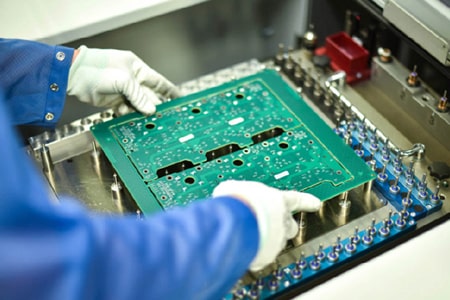
3. Manage PCB Warpage
Warpage becomes more critical as board thickness, layer count and component density increase.
PCB construction, copper balance, panelization and reflow conditions should be reviewed together. Excessive warpage can contribute to inconsistent solder paste transfer, open BGA joints and head-in-pillow defects.
For demanding boards, warpage control should be included in the DFM and process-validation stage rather than addressed after production.
4. Verify Hidden BGA Joints With X-Ray
AOI can cover visible solder joints and surrounding components, but BGA joints require X-ray inspection for deeper process verification.
Typical inspection targets include:
For critical assemblies, X-ray criteria should be defined before volume production.
5. Validate the Process Before Volume Builds
A controlled first article process can follow:
DFM Review → Stencil Printing → SPI → Placement → Reflow Profiling → AOI → X-Ray → Electrical Testing
The goal is to establish a repeatable process window for solder paste volume, thermal profile, BGA joint quality and PCB warpage.
Once validated, these parameters become the baseline for subsequent production batches.
Key Risk Controls
| Risk | Process Control |
| BGA open joints | SPI + reflow optimization + X-ray |
| Head-in-pillow | DFM review + paste control + profile optimization |
| PCB warpage | PCB structure + copper balance + thermal control |
| Excessive voiding | Paste/reflow optimization + X-ray |
| Second-reflow movement | Component assessment + profile control |
| Process variation | First article + defined process parameters |
For complex double-sided BGA projects, early engineering review can identify risks before they affect production yield.
PCBAMake provides BGA PCB assembly, SMT production, SPI, AOI, X-ray inspection and functional testing. Send your Gerber files, BOM or assembly requirements for an engineering and DFM review.
If you have PCB/PCBA/OEM/ODM needs, please contact us, We will reply within 2 hours, and complete the quotation within 4 hours or less upon request.
Delivery Services

Verified by

Link Us on